
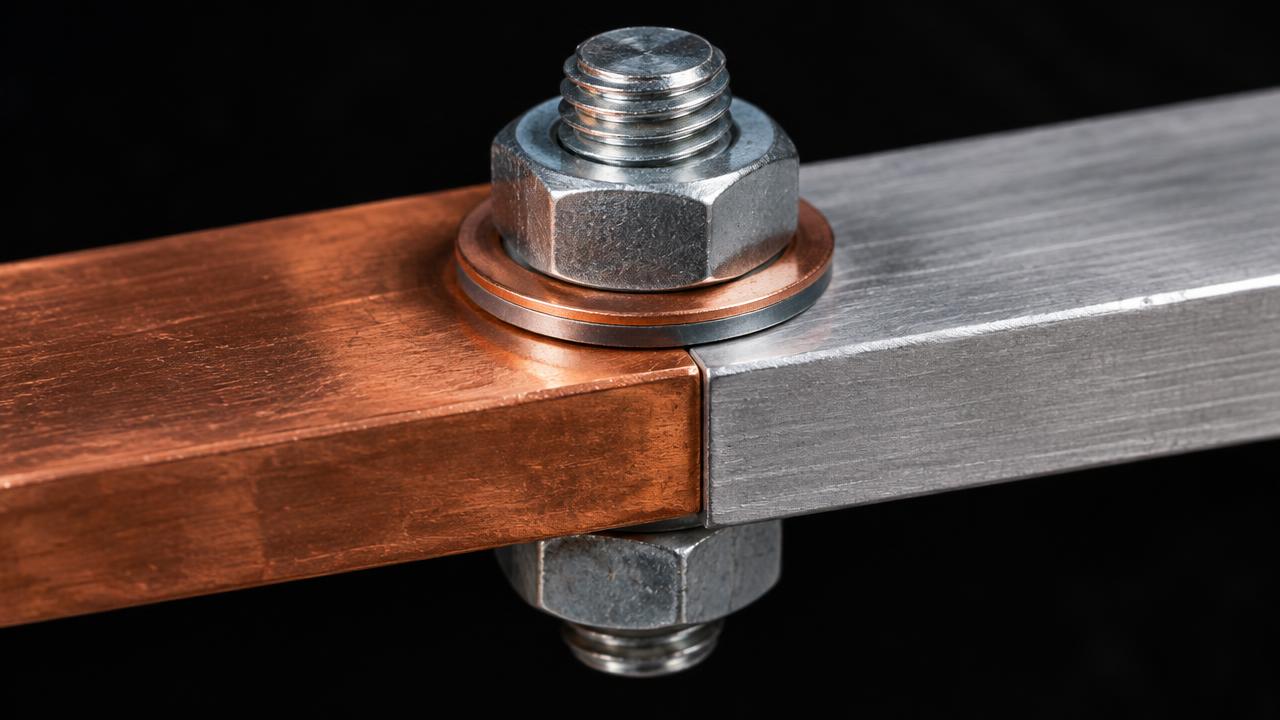
Joining Copper to Aluminum: How to Prevent Galvanic Corrosion at Bus Connections
Mixed-metal systems are everywhere: aluminum feeders landing on copper switchgear bus, aluminum transformer terminals bolted to copper connectors, and retrofits that splice new conductors into old. Done correctly, a copper-to-aluminum joint can last the life of the equipment. Done poorly, it becomes a hot spot.
Why Copper–Aluminum Joints Fail
Three mechanisms drive most failures:
- Galvanic corrosion. Aluminum is anodic to copper. In the presence of moisture (an electrolyte), aluminum corrodes preferentially at the interface, raising contact resistance. The Copper Development Association and NEMA both highlight this as a primary concern in mixed-metal terminations.
- Differential thermal expansion. Aluminum expands about 40% more than copper per degree. Repeated load cycling loosens bolted joints over time.
- Oxide film. Aluminum instantly forms a hard, insulating oxide layer that must be broken and kept from reforming.
Proven Prevention Methods
1. Tin Plating
Tin-plating the copper side (or both sides) places a metal between copper and aluminum on the galvanic series, dramatically reducing the potential difference. It's the most common specification for copper bus bar intended to mate with aluminum.
2. Bimetallic Transition Plates
Friction-welded or roll-bonded copper/aluminum plates move the dissimilar interface into a metallurgically bonded zone that moisture can't reach, so each side bolts to its own metal.
3. Joint Compound
Oxide-inhibiting compounds exclude moisture and help break through aluminum oxide when the joint is tightened. Wire-brush aluminum contact surfaces immediately before applying compound.
4. Proper Hardware
Use plated steel or stainless bolts with Belleville (conical spring) washers to maintain clamping force through thermal cycles. Flat washers alone allow joints to relax. Research archived by OSTI on aluminum connection performance documents how sustained contact pressure is key to long-term stability.
5. Correct Torque and Re-inspection
Follow the equipment manufacturer's torque values and include infrared thermography in maintenance programs, per NFPA 70B.
Quick Reference
| Situation | Recommended Approach |
|---|---|
| Indoor, dry switchgear | Tin-plated copper + compound + Belleville washers |
| Outdoor / humid | Bimetallic transition or tin-plated both sides, sealed |
| High cycling loads | Bimetallic plate + spring washers + IR inspection |
Selecting the aluminum side matters too — see why 6101 and 6063 dominate electrical applications.
Need tin-plated copper or matched aluminum bus? Contact Maverick Metals for copper and aluminum busbar cut, punched, and plated to your print.