
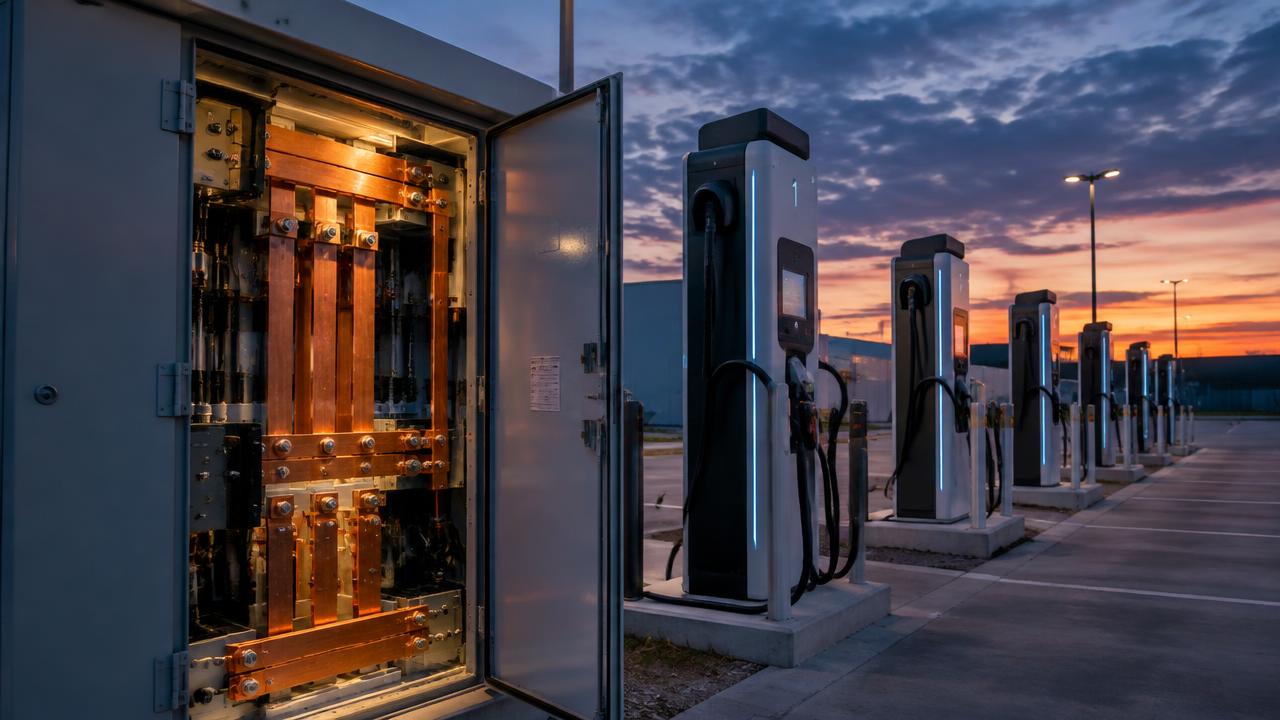
Copper and Aluminum in EV Charging Infrastructure: What Buyers Need to Know
The build-out of public and fleet EV charging is one of the fastest-growing sources of conductor demand in North America. Every charger, from a Level 2 wall unit to a 350 kW DC fast charger, sits at the end of a chain of transformers, switchgear, and bus that is built from copper and aluminum.
The Scale of the Build-Out
The IEA Global EV Outlook tracks millions of public charging points worldwide, with growth concentrated in fast charging. In the U.S., the Department of Energy Alternative Fuels Data Center publishes real-time station counts that continue to climb quarter over quarter. Each high-power site typically requires a dedicated service, a pad-mount transformer, and distribution equipment.
Where Copper Is Used
- Inside DC fast chargers — power modules, internal copper bus bar, and liquid-cooled cable assemblies where compact high-current paths are essential.
- Switchboards and panelboards — main and branch bus for multi-charger sites.
- Grounding — ground rods, ground bars, and bonding jumpers.
- Transformer windings — many distribution transformers still use copper for compactness and efficiency.
Where Aluminum Is Used
- Service entrance and feeder conductors — aluminum's lower weight and cost make it common for long underground runs.
- Switchgear bus — aluminum busbar in 6101 alloy is widely used in larger, less space-constrained gear.
- Transformer windings — aluminum foil and strip windings are common in pad-mount units.
- Enclosures and canopies — aluminum sheet for corrosion-resistant housings.
Copper vs. Aluminum Trade-Offs at Charging Sites
| Factor | Copper | Aluminum |
|---|---|---|
| Conductivity | ~100% IACS | ~57–61% IACS |
| Space efficiency | Best — smaller cross-section | Needs ~1.6x the area |
| Weight | Heavier | ~1/3 the density |
| Cost per ampere | Higher | Lower |
For a deeper look, see our copper vs. aluminum bus bar comparison.
Procurement Considerations
Charging programs often roll out in waves of dozens or hundreds of sites. That makes them ideal candidates for blanket orders with scheduled releases and indexed pricing tied to COMEX copper or the Midwest aluminum average. Locking in fabrication specs early — hole patterns, plating, bends — lets suppliers stage material ahead of each wave.
Supplying an EV charging program? Talk to Maverick Metals about bus bar, flat bar, and sheet programs built around your rollout schedule.