
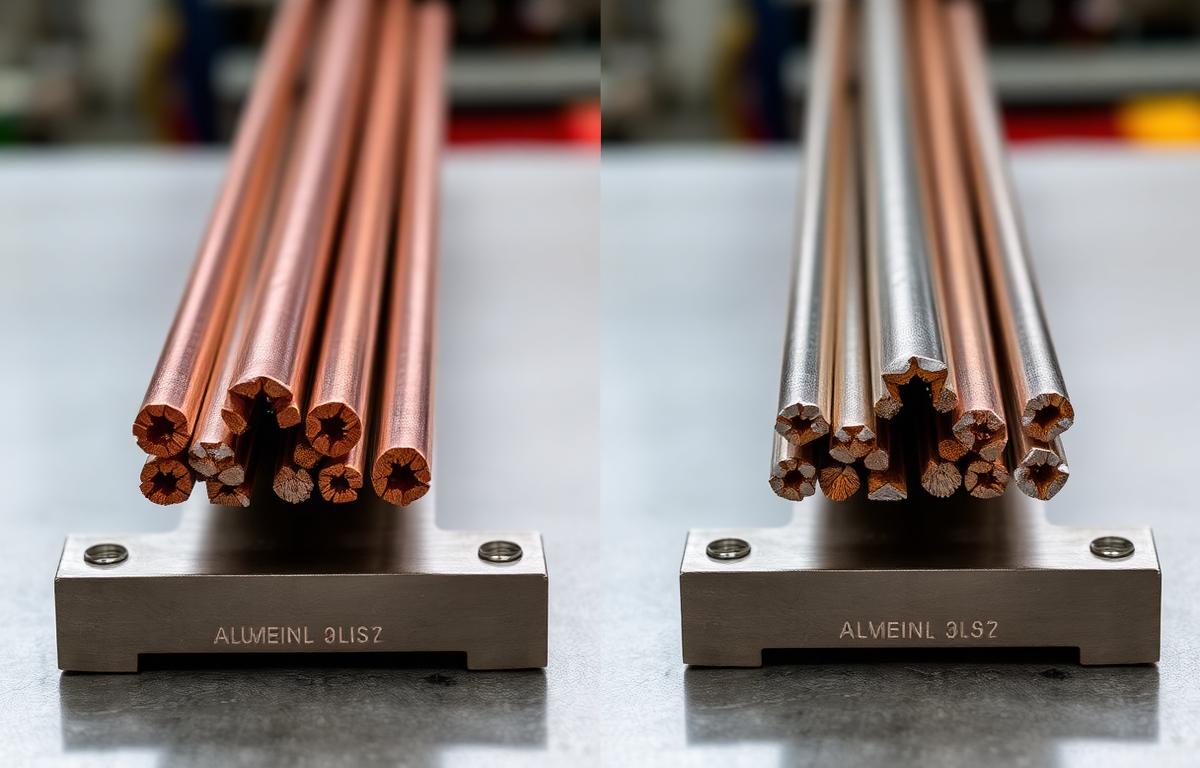
Copper vs. Aluminum Bus Bar in Power Distribution: A Practical Engineering Comparison
The copper-versus-aluminum question in bus bar specification is one of the most consequential material decisions in power distribution design, and it is rarely as simple as running a cost-per-pound comparison. The correct answer depends on the specific application: current density requirements, available cross-sectional envelope, installation geometry, operating environment, and total lifecycle cost. This article provides an engineering-grounded comparison across the parameters that actually determine performance in service.
Electrical Performance: The Conductivity Gap
At 20°C, annealed copper achieves 101% IACS electrical conductivity, while aluminum (alloy 1350) achieves 61% IACS.
| Property | Copper | Aluminum |
|---|---|---|
| IACS Conductivity | 101% | 61% |
| Electrical Resistance | 17.2 nΩ·mm | 28.3 nΩ·mm |
| Thermal Conductivity | 397 W/m·K | 230 W/m·K |
| Current Density | ~1.2 A/mm² | ~0.8 A/mm² |
| Cross-Section for Equal Ampacity | Baseline | ~56% larger |
The practical consequence of this conductivity gap is cross-sectional sizing. Aluminum requires approximately 56% larger cross-sections to match copper's current-carrying capacity.
However, the weight math inverts when you account for density. Aluminum has 62% the conductivity of copper by volume, but aluminum can be as much as 70% lighter than copper. Even when accounting for the larger size of an aluminum system, the busbar still weighs significantly less. And when conductivity is compared by weight rather than volume, aluminum is actually 50% more conductive per kilogram.
This is the fundamental tension engineers must resolve: copper wins by volume, aluminum wins by weight. The appropriate axis of comparison is determined by the constraints of the specific application.
Mechanical Properties and Joint Reliability
Copper's mechanical advantages extend beyond raw conductivity. The fatigue strength of copper is approximately double that of aluminum in the conditions in which high-conductivity copper and aluminum are used.
Joint reliability is the area where copper maintains its most significant practical advantage over aluminum. Copper's oxide layer remains conductive and stable, whereas aluminum forms a resistive oxide rapidly on freshly exposed surfaces. Anti-oxidant compound must be applied to all aluminum connections per NEMA BU 1.2, and improper compound application is the number-one cause of aluminum busbar failures — responsible for 60% of cases.
Copper also tolerates more demanding connection cycling. In applications with frequent maintenance access, high thermal cycling, or vibration loading, copper's greater ductility and oxide stability reduce the risk of joint degradation over time. Aluminum joints that are not properly torqued can develop progressive contact resistance — a failure mode that manifests as localized heating rather than immediate circuit failure.
When mixing materials — for instance, connecting aluminum feeders to a copper bus — bimetallic lugs or plates listed for Cu-Al transitions are required. Bare copper-to-aluminum contact causes galvanic corrosion, which is a code expectation per NEC 110.14 and UL 486.
Weight, Installation, and Structural Loading
In large substation and distribution board applications, weight becomes a structural engineering variable. Aluminum's lighter weight reduces overall assembly weight, and fabricators can form and machine aluminum with less effort than copper, which can shorten lead times for higher-volume work.
The reduced weight creates cost savings in several areas: fewer supports are required, transportation costs are reduced, and fewer personnel are needed for installation. In multi-story or overhead bus applications, structural loading on support systems is a real design constraint.
The offsetting consideration is dimensional envelope. Aluminum components are larger — so much larger that overall dimensions may restrict the use of aluminum in certain applications. Small buildings or underfloor applications may be physically prevented by the sheer size of an aluminum busbar system of equivalent ampacity. In compact switchgear lineups, motor control centers, and data center PDUs, the available space often makes copper the only viable option.
Application-Specific Decision Matrix
| Application | Recommended Material | Why |
|---|---|---|
| Indoor switchgear / control panels | Copper | Limited space, stable contact pressure |
| Data center PDUs & UPS | Copper | Compact form factor, reliability |
| Motor control centers | Copper | Thermal cycling performance |
| High-current / high-temp environments | Copper | Low voltage drop, mechanical strength |
| Utility-scale power systems | Aluminum | Weight savings at scale |
| Large distribution boards | Aluminum | Generous spatial envelope |
| Long industrial bus runs | Aluminum | Reduced structural costs |
| Solar / EV infrastructure | Aluminum | First-cost constraint, lighter weight |
Hybrid approaches are increasingly common and well-supported by current engineering practice. Properly designed hybrid systems — copper for compact distribution equipment, aluminum for feeders and long runs, with proper transitions — can achieve 20–30% total cost reduction while maintaining near-copper performance.
Standards and Compliance
Both materials are governed by well-established standards:
- IEC 61439 — specifies design rules for electrical panels including temperature rise, short-circuit performance, and dielectric strength for both copper and aluminum busbars
- UL 891 — covers low-voltage power distribution switchboards in North American markets, defining conductor sizing, insulation spacing, and short-circuit ratings
Engineers specifying either material should confirm that the assembly carries a verified type test certificate or design verification record under the applicable standard before installation.
The copper-aluminum decision is not a contest with a universal winner — it is an optimization problem with application-specific inputs. Specify accordingly.
Need material for your next bus bar project? Request a quote from Maverick Metals — we supply both copper and aluminum bus bar to specification.