
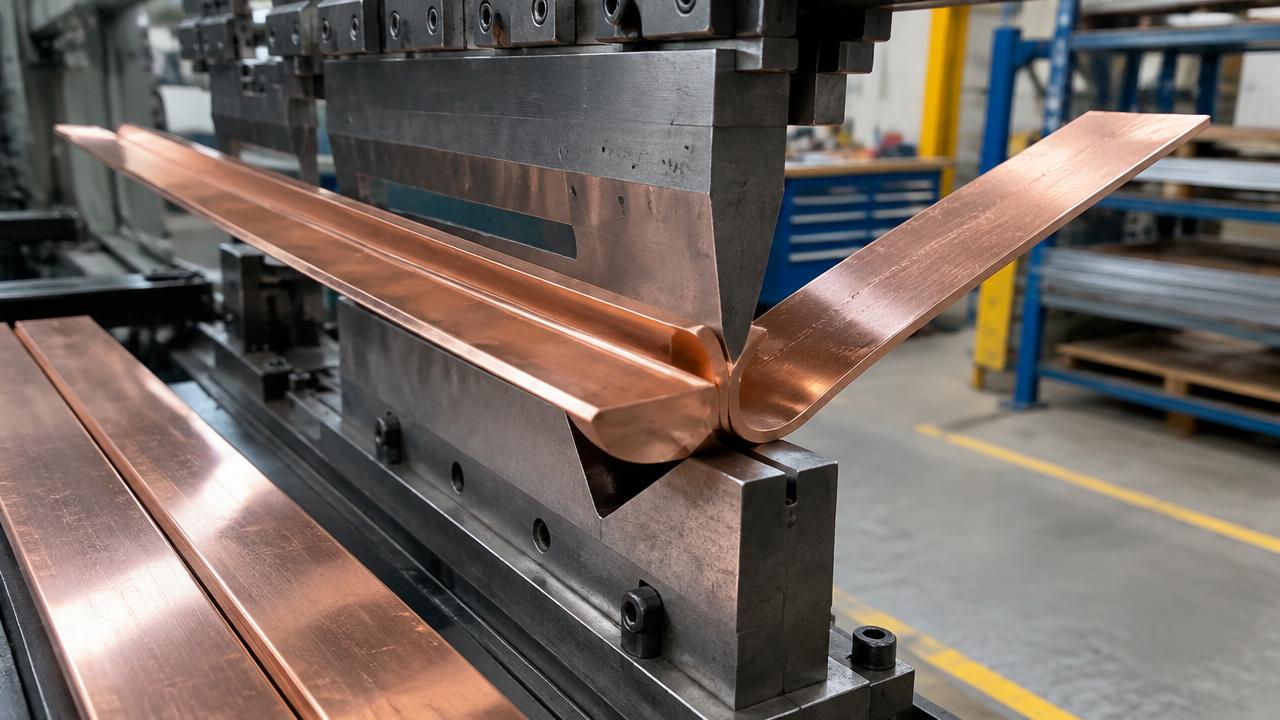
Copper Temper Designations Explained: O60, H00, H02, H04 and What They Mean for Fabrication
Two pieces of C110 copper can have identical chemistry and conductivity yet behave completely differently in the shop. The difference is temper — the degree of cold work or annealing the metal has received. Specifying the right temper is one of the simplest ways to prevent cracked bends, excessive springback, and rejected parts.
How Temper Codes Work
Copper and copper alloy tempers are defined in ASTM B601. The letter prefix describes how the temper was produced:
- O — annealed (softened by heat treatment)
- H — cold worked (hardened by rolling or drawing)
- M — as-manufactured (hot rolled, cast, or extruded)
Common Tempers for Copper Bar and Sheet
| Code | Common Name | Relative Hardness | Typical Use |
|---|---|---|---|
| O60 | Soft anneal | Softest | Deep forming, tight bends, flexible connectors |
| H00 | Eighth hard | Low | General bus bar, moderate bending |
| H01 | Quarter hard | Low–medium | Bending with better flatness |
| H02 | Half hard | Medium | Machined parts, stiff bus, punching |
| H04 | Hard | High | Springs, contacts, rigid components |
Exact tensile and hardness ranges for each temper vary by product form and thickness — see the CDA properties database and the applicable product standard (for example, ASTM B187 for bus bar, rod, and shapes).
Choosing a Temper for Bending
Softer tempers allow tighter inside bend radii without cracking. As a rule of thumb, edgewise and flatwise bends on thick bus bar are far more forgiving in O60 or H00 than in H02. Harder tempers also produce more springback, which must be compensated for in tooling. If your part has multiple bends close together, discuss temper with your supplier before ordering.
Choosing a Temper for Machining and Punching
Very soft copper tends to "gum up" during machining and can smear at punched holes. H02 half hard typically gives cleaner edges, better chip formation, and flatter parts after punching — which is why it's a common choice for machined copper components.
Does Temper Affect Conductivity?
Only slightly. Cold work reduces conductivity by a small amount — usually a percent or two IACS — which is negligible for most power applications. Annealed copper is the reference for 100% IACS.
Practical Ordering Tips
- Always state temper on your PO and drawing — "C110" alone is incomplete.
- Match temper to the most demanding operation (usually the tightest bend).
- Ask for mill certs confirming temper and mechanical properties.
Explore available forms: copper bus bar, copper sheet, round bar, and C110 copper. Unsure which temper fits your part? Ask our team.