
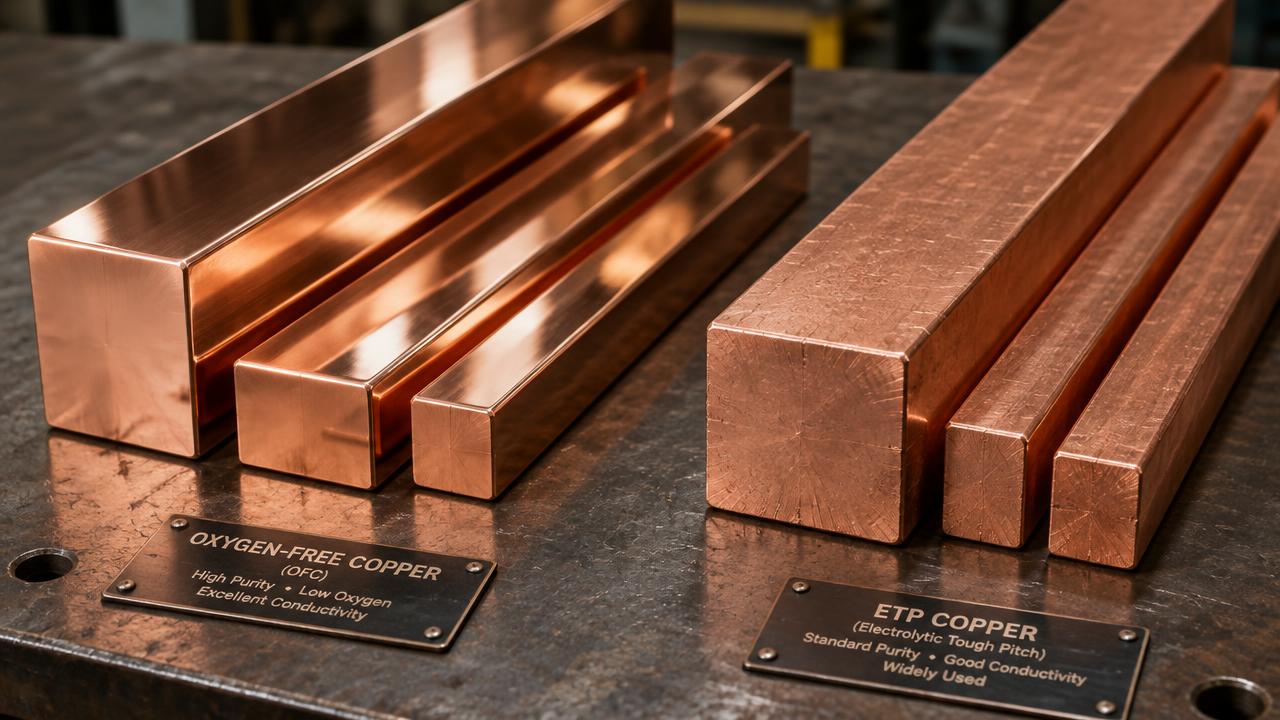
C101 vs. C110 Copper: When Oxygen-Free Copper Is Worth the Premium
On paper, C10100 (oxygen-free electronic, OFE) and C11000 (electrolytic tough pitch, ETP) copper look almost interchangeable. Both are rated at roughly 100–101% IACS conductivity, both are sold in bar, sheet, and rod, and both carry the same density and thermal properties. Yet C101 routinely costs more and carries longer lead times. Understanding why — and when that matters — saves buyers money and saves engineers from field failures.
The Real Difference: Oxygen Content
ETP copper contains a small, intentional amount of oxygen (typically 0.02–0.04%) present as cuprous oxide. Oxygen-free grades are refined and cast in controlled atmospheres to bring oxygen down to 0.0005% or less, with C101 also certified to 99.99% copper purity. The Copper Development Association alloy database lists both grades with their full composition limits.
| Property | C11000 (ETP) | C10100 (OFE) |
|---|---|---|
| Copper purity | 99.90% min | 99.99% min |
| Oxygen | ~0.02–0.04% | 0.0005% max |
| Conductivity | ~100% IACS | ~101% IACS |
| Hydrogen embrittlement resistance | Poor | Excellent |
| Relative cost | Baseline | Premium |
Why Oxygen Matters: Hydrogen Embrittlement
When ETP copper is heated above roughly 400°C in a hydrogen-bearing atmosphere — common in torch brazing and some furnace processes — hydrogen diffuses into the metal and reacts with the cuprous oxide to form steam. That steam can't escape, creating internal voids and cracks along grain boundaries. The result is a part that looks fine but fails under bending or vibration. ASTM B577 defines test methods specifically for detecting cuprous oxide and susceptibility to this failure mode.
Oxygen-free copper has essentially no oxide to react, so it can be brazed, hydrogen-annealed, or welded without that risk.
Where C101 Earns Its Premium
- Vacuum and high-vacuum equipment — low outgassing makes OFE copper the default for particle accelerators, vacuum tubes, and semiconductor tooling.
- Brazed assemblies — induction coils, water-cooled bus, and heat exchangers that see hydrogen-bearing braze atmospheres.
- Cryogenic and superconducting systems — where residual resistivity ratio (RRR) matters.
- High-reliability electronics — waveguides, RF components, and audio/signal conductors.
Where C110 Is the Right Call
For the vast majority of power distribution work — copper bus bar in switchgear, grounding bars, flat bar connectors, and bolted assemblies — C110 copper delivers the same conductivity at lower cost and better availability. If parts are bolted, crimped, or mechanically joined rather than brazed in reducing atmospheres, the oxygen content is irrelevant to performance.
A Middle Option: C102
C10200 (oxygen-free, 99.95% Cu) offers the embrittlement resistance of oxygen-free copper without C101's four-nines certification. For many brazed electrical assemblies, C102 is the practical compromise.
Bottom Line for Buyers
Ask one question before upgrading to C101: Will this part be brazed, welded, or annealed in a hydrogen-bearing atmosphere, or used in vacuum? If not, C110 is almost always the economical, technically sound choice. If yes, the premium buys real reliability.
Not sure which grade your drawing calls for? Contact Maverick Metals — our team will review your application and quote C110, C102, or C101 in the copper forms you need.