
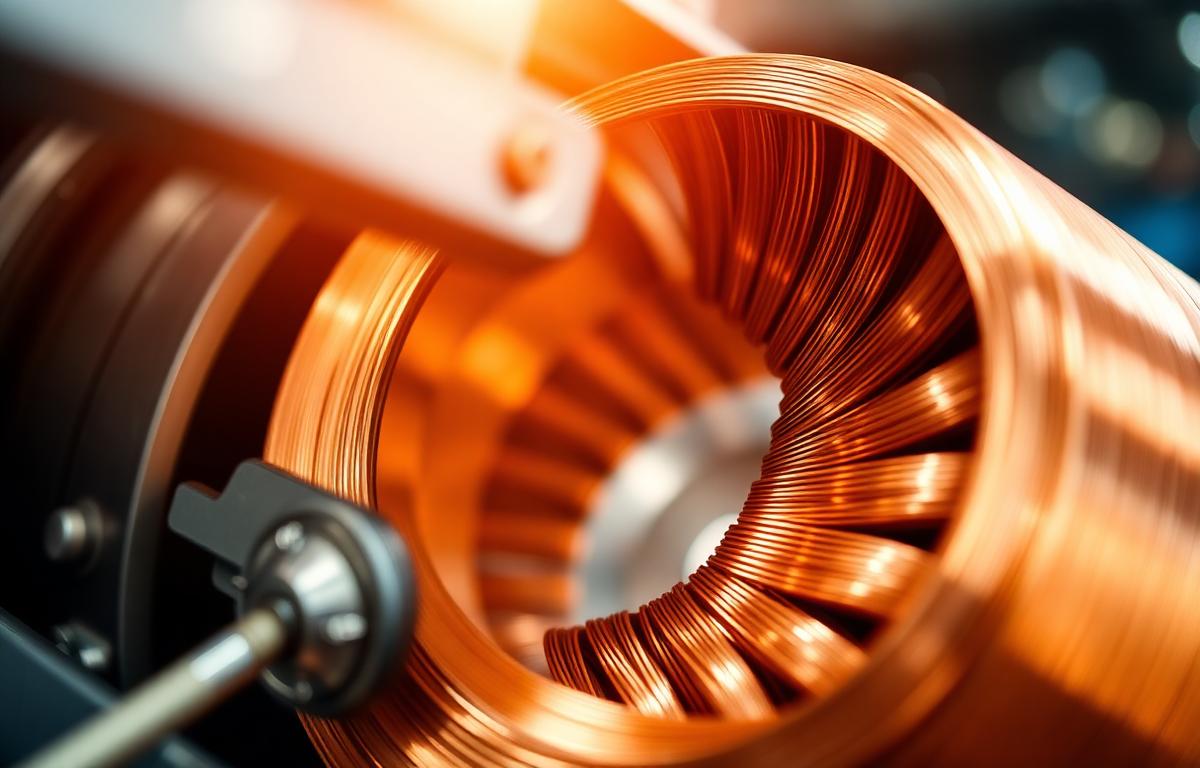
The Role of High-Conductivity Copper in Transformer Manufacturing
Transformer manufacturing is one of the most conductivity-sensitive applications in the electrical industry. The copper in a transformer winding is not a passive structural component — it is the active medium through which electrical energy is transferred between circuits, and its resistive losses represent the difference between a transformer that meets its efficiency nameplate and one that runs hot, ages prematurely, or fails type testing.
Why Conductivity Is the Governing Parameter
In a transformer, winding copper carries continuous current under a defined thermal budget. The I²R losses in the windings — called copper losses or load losses — scale with the electrical resistivity of the conductor. Every increment of resistivity above the theoretical minimum represents real heat that must be dissipated through the cooling system.
The electrical properties of high-conductivity copper were standardized in 1913 by the International Electrotechnical Commission, which defined the International Annealed Copper Standard (IACS). At 20°C, copper achieves a volume conductivity of 58 MS/m at 100% IACS, with a temperature coefficient of resistivity of 0.0039 per °K.
As winding temperature rises under load, resistivity increases — which increases losses, which generates more heat. This is the positive feedback loop that transformer thermal design works to contain. High-conductivity copper starts this loop from a more favorable position.
Alloy Selection: C11000 as the Industry Standard
The dominant copper grade for transformer windings is C11000 (ETP copper), the same alloy that governs the majority of power distribution applications. C11000 ETP copper possesses electrical conductivity of up to 101% IACS and is highly valued for use in foil-wound transformers within electrical transmissions and panels, as it is less susceptible to metal fatigue than other metals.
The oxygen content of ETP copper — approximately 300–400 ppm — serves a critical metallurgical function. In C11000 copper, oxygen serves as an alloying element that effectively eliminates solute elements from the metal. If left in solid solution, these solutes would raise resistivity. Because the oxide inclusions do not affect electrical conductivity, ETP copper achieves its maximum conductivity while remaining commercially producible at scale.
For transformer windings that require furnace annealing or heat treatment in a hydrogen-containing atmosphere, oxygen-free copper (C101, UNS C10200) is the required alternative. The Cu₂O inclusions in C110 react with hydrogen at elevated temperatures to form steam, generating intergranular pressure that causes brittle fracture — a failure mechanism that can destroy a winding during manufacturing.
Forms of Copper Used in Transformer Manufacture
Transformer windings use copper in forms that differ substantially from the flat bus bar used in switchgear and distribution panels:
| Form | Application | Key Requirements |
|---|---|---|
| Rectangular Strip / Foil | Foil-wound designs | Flat, smooth, burr-free surface; tight thickness tolerance |
| Round Magnet Wire | Layer & disc windings | Consistent diameter, insulation coating adhesion |
| Rectangular Magnet Wire | High-current windings | Controlled corner radius, space efficiency |
C11000 copper foil for transformer winding has advantages of good electrical conductivity, low resistance loss, and superior surface quality. The transformer manufactured with C11000 copper foil windings has a small no-load current loss, a low no-load current noise level, and excellent heat dissipation performance.
Surface quality is a specification parameter that carries real engineering weight. The foil strip must have a flat, smooth, clean surface free of scratches. The copper foil can be made into a double-sided coated product using insulating materials such as polyester film or polypropylene film, which is then wound together with insulating layers to form the complete winding assembly.
The Annealing Process
The annealing process is the core of rolling pure copper for transformer applications. The deformation resistance and conductivity of rolled copper foil are closely related to the annealing process. Inadequate annealing will cause the copper foil to be brittle, prone to cracking during winding, and difficult to bend around the mandrel. Fully annealed (O61 temper) copper is specified for winding applications precisely because the forming stresses imposed during coil winding require maximum ductility.
Dimensional Tolerances and Their Impact
In transformer manufacturing, dimensional precision in copper strip translates directly into winding geometry, and winding geometry determines leakage inductance, voltage regulation, and short-circuit withstand performance.
A winding wound with strip that varies in thickness produces non-uniform turn-to-turn insulation compression, which creates localized dielectric stress concentrations — a precursor to insulation failure under impulse voltage testing.
| Parameter | Typical Specification |
|---|---|
| Copper Purity | ≥99.9% (high conductivity) |
| Width Tolerance | ±0.2 mm |
| Thickness Control | ±5 microns |
| IACS Conductivity | ≥99.80% |
| Side Camber | ≤2 mm per meter |
| Temper | Fully annealed (O61) |
Procurement teams sourcing copper strip for transformer manufacturing should treat these tolerances as hard requirements, not guidelines.
Thermal Management and the Copper-Insulation System
In oil-filled power transformers, the copper windings and the insulation system — typically Kraft paper and pressboard — operate as an integrated thermal assembly. The copper generates heat; the oil carries it away.
The tensile strength of C11000 copper foil allows it to be stretched to a high elongation ratio of up to 30%. C11000 copper foil also has good corrosion resistance and weldability. These mechanical properties matter during short-circuit events, when the electromagnetic forces between winding turns can reach magnitudes that would deform or rupture weaker conductors.
Dry-type transformers impose even more demanding requirements on the copper-insulation interface, because heat management relies entirely on the thermal conductivity of the conductor and convective air cooling. High-conductivity copper's thermal conductivity advantage over aluminum — approximately 73% higher — is a meaningful factor in dry-type designs operating at high load factors.
Specifying Copper for Transformer Production
When sourcing copper for transformer manufacturing, the specification package must address:
- Alloy designation — C11000 for most applications, C10200 where hydrogen atmosphere processing is involved
- Temper — O61 fully annealed for winding applications
- Surface finish — bright annealed, burr-free, with tight camber control
- Dimensional tolerances — matching the design requirements of the specific transformer class
Mill test reports should confirm conductivity at or above the minimum IACS requirement. A supplier providing copper that tests at 98% IACS when the specification demands 101% will produce resistive heating in a high-amperage assembly that could exceed thermal limits.
The transformer copper supply chain rewards suppliers who understand this application — who can deliver consistent material, complete documentation, and the dimensional precision that transformer manufacturing demands.
Specifying copper for transformer production? Contact Maverick Metals to discuss C110, copper coil, copper sheet, and custom strip programs for your winding applications.