
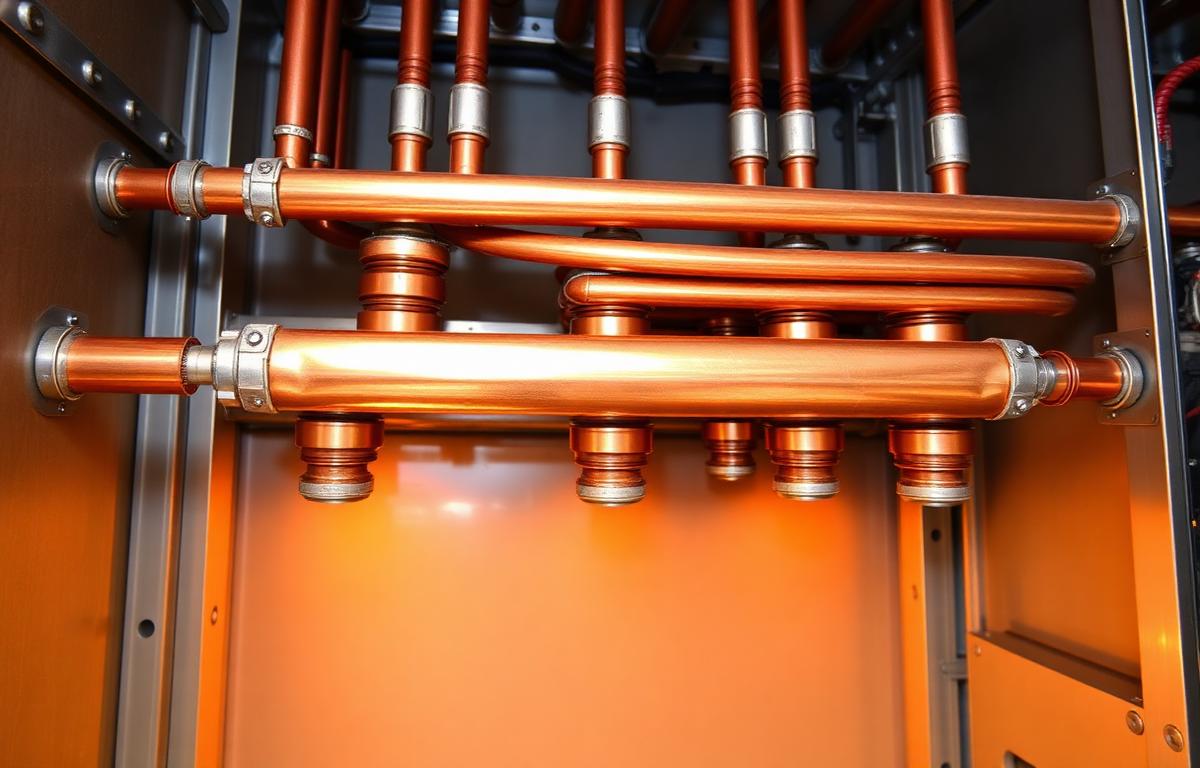
How Copper Bus Bar Is Used in Substation Design and Why Grade Matters
Substation bus design is one of the more demanding disciplines in electrical engineering — it sits at the intersection of thermal management, mechanical loading, fault current physics, and long-term reliability. The conductor you specify at this stage will define both the operational performance and the maintenance burden of the installation for decades. Copper bus bar remains the material of choice for high-current, indoor, and expansion applications in substations, but not all copper is interchangeable. Grade selection at the specification phase is not a formality — it has direct engineering consequences.
The Role of Bus Bar in Substation Architecture
Substation rigid and strain bus structure design involves electrical, mechanical, and structural considerations. IEEE Std 605 integrates these into a single design framework covering ampacity, radio influence, vibration, and electromechanical forces resulting from gravity, wind, fault current, and thermal expansion.
Within that framework, three primary bus system types are deployed:
| Bus Type | Common Use | Key Advantage |
|---|---|---|
| Rigid Bus | Most common in North America | Simplicity, ease of maintenance |
| Strain (Flexible) Bus | 230 kV+ substations | High-capacity, seismic withstand |
| Gas-Insulated Bus | Space-constrained sites | ~10% footprint of air-insulated |
Copper bus bar is primarily associated with rigid bus configurations, particularly in indoor switchgear lineups, high-current jumpers, grounding systems, and substation expansion work where the existing conductor material is already copper and dissimilar-metal joints must be avoided.
Thermal and Fault Current Sizing
The first sizing constraint in any bus design is continuous ampacity — the maximum current the bar can carry without exceeding the allowable temperature rise. Cross-section is designed on the basis of rated normal current and permissible temperature rise, and then verified for temperature rise under short-time short circuit current. Some specifications call for busbar sizing according to current density — for example, the NEC requires 1,000 A/in² for copper bus.
The short circuit case often controls the design in high-fault substations. Because of the large currents involved, short circuit protection of busbar systems needs careful consideration. The critical issues are the temperature rise during the fault event and the magnitude of the electromagnetic forces generated, which may cause deformation of the bars and failure of mountings.
The fatigue strength of copper is approximately double that of aluminium, giving a useful reserve of strength against failure initiated by mechanical or thermal loading.
In fault scenarios, bus bars experience not only thermal stress but electromagnetic forces between parallel conductors — copper's superior strength and stiffness translate directly to structural margin under these loads.
Why Grade Matters: C110 vs. C101
The two copper grades specified most commonly for substation bus bar work are C11000 (Electrolytic Tough Pitch, or ETP) and C10200 (Oxygen-Free Electronic, or OFE). The distinction is not marginal.
| Property | C110 (ETP) | C101 (OFE) |
|---|---|---|
| IACS Conductivity | 101% | 102% |
| Electrical Resistance | 17.2 nΩ·mm | 17.2 nΩ·mm |
| Thermal Conductivity | 397 W/m·K | 397 W/m·K |
| Melting Point | 1,083°C | 1,083°C |
| Oxygen Content | 300–400 ppm | < 10 ppm |
| Hydrogen Embrittlement Risk | Yes (above 370°C) | No |
| Typical Cost Premium | Baseline | +20–40% |
Hydrogen Embrittlement — The Critical Limitation of C110
Hydrogen embrittlement is the critical limitation of C110 copper. When C110 is heated above approximately 370°C in a hydrogen-containing atmosphere, the Cu₂O inclusions react with atomic hydrogen to form steam:
Cu₂O + H₂ → 2Cu + H₂O
The steam cannot escape the metal lattice, builds pressure at grain boundaries above the copper yield strength, and causes intergranular cracking — a brittle fracture with no necking and no ductility.
In practice, this matters most for bus bar assemblies that require furnace brazing or hydrogen-atmosphere heat treatment. C101 is immune to this effect because it is oxygen-free. For air-cooled assemblies or bolted joints, the standard purity of C11000 is more than sufficient.
For bolted bus bar connections — the dominant joining method in substation applications — C110 is the correct and cost-effective choice. The fabrication premium for C101 is typically 20–40% higher than C110.
Silver-Bearing Grades
Silver-bearing grades such as C116 occupy a distinct niche in high-temperature environments. Where higher stresses or working temperatures are expected, copper containing small amounts of silver (about 0.1%) is used. The creep resistance and softening resistance of copper-silver alloys increase with increasing silver content. These grades are worth specifying in substations where bus bar operating temperatures are elevated by high ambient conditions or proximity to heat-generating equipment.
ASTM Standards and Material Certification
Proper procurement requires material traceability. For bus bar applications, the governing ASTM standard is B187, which covers copper bus bar, rod, and shapes. ASTM B187 outlines requirements for tensile strength, Rockwell hardness, and electrical resistivity.
A supplier providing copper that tests at 98% IACS when the specification demands 101% will produce resistive heating (I²R losses) in a high-amperage switchgear cabinet that exceeds thermal limits and violates safety standards.
Mill test reports (MTRs) should be a contractual requirement on any substation copper procurement — not an afterthought. Verify that the MTR confirms copper purity (≥99.9%), oxygen content (if C101 is specified), and conductivity as measured against the IACS standard. For defense or government-adjacent projects, additional DFARS documentation requirements will apply.
Practical Design Considerations
Bus bar orientation affects ampacity significantly. Horizontal bars with the wide face exposed to airflow cool more efficiently than vertically mounted bars of identical cross section. In enclosed switchgear lineups, enclosure sizing, proximity to adjacent heat sources, and available ventilation all factor into the thermal design.
The issues that must be addressed include current-carrying capacity, short circuit withstand, jointing method, and maintenance requirements. Because the cost of lifetime energy losses is far greater than the cost of first installation, designing for lower energy loss — even at higher initial material cost — yields lower lifetime costs.
Copper bus bar remains the superior choice for indoor substation applications, compact equipment bays, high-fault-level environments, and any installation where minimizing conductor cross section is a spatial or structural priority. The grade you specify — C110, C101, or silver-bearing — should follow from the fabrication method, the operating temperature, and the joining technique, not from catalog defaults.
Need help specifying the right copper grade for your substation project? Contact Maverick Metals for material guidance and competitive pricing on certified copper bus bar.